The Complete Guide to Pallet Wrapping Efficiency: Hand Grade vs. Machine Grade Stretch Wrap for US Warehouses
Every day, millions of pallets move through US warehouses and distribution centers. At the end of each packing line, one critical decision determines whether those pallets arrive intact or damaged: the choice of stretch wrap and wrapping method. With pallet-related damages costing US businesses an estimated $2.5 billion annually, getting this right isn’t just about efficiency—it’s about protecting your bottom line.
This comprehensive guide draws from ASTM D4649-20(2025), the industry standard for stretch film selection and application, to help you make informed decisions for your operation.
Understanding Stretch Wrap Fundamentals
What Is Stretch Wrap?
Stretch wrap is a highly stretchable plastic film used to unitize, stabilize, and protect products on pallets during storage and transport. The key performance characteristics include:
- Cling: The film’s ability to stick to itself without adhesive
- Memory: How well the film retains its stretched position
- Puncture resistance: Ability to withstand sharp corners and irregular loads
- Tensile strength: Maximum force the film can withstand before breaking
The Stretch Percentage Myth
Many buyers focus on “300% stretch” claims, but real-world stretch varies significantly. According to ASTM standards, effective stretch percentages typically range from 50-250% depending on equipment and film grade. What matters most is load containment force—the actual pressure holding your pallet together.
Hand Grade Stretch Wrap Deep Dive
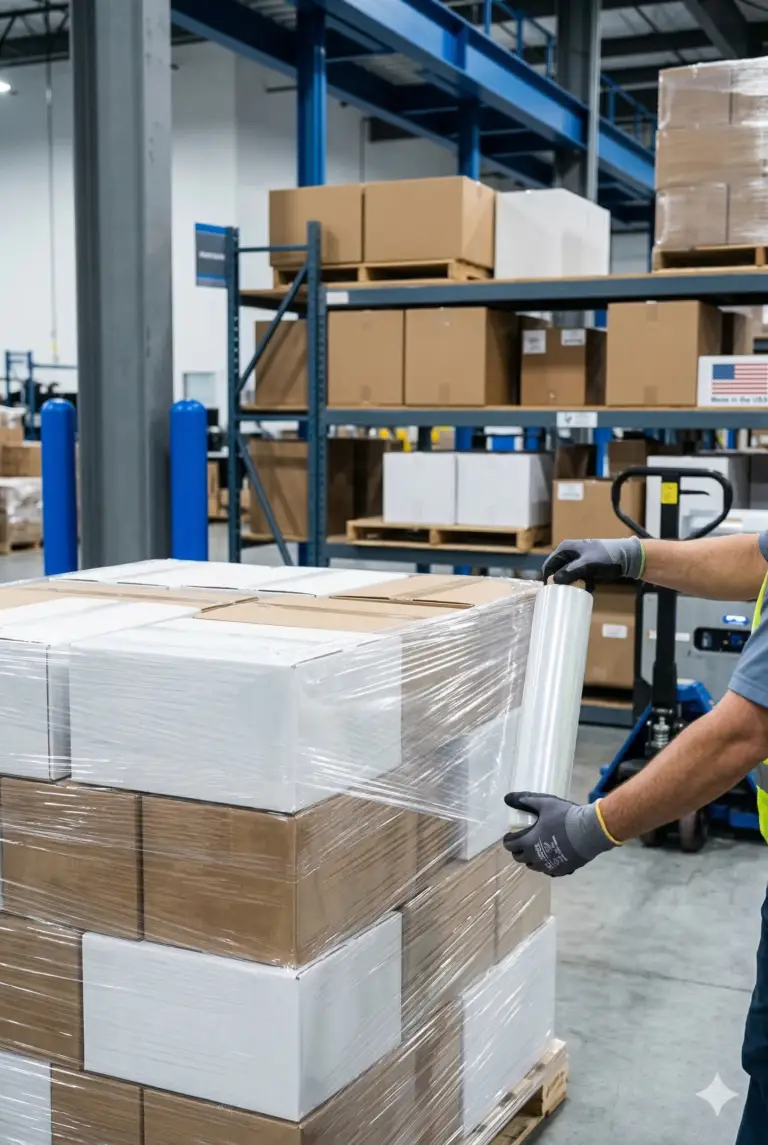
Hand grade stretch wrap comes on smaller rolls (typically 12-18 inches wide, 1,000-2,000 feet long) designed for manual application. It’s the workhorse of low-to-moderate volume operations.
When Hand Grade Makes Sense:
- Facilities wrapping fewer than 40 pallets per day
- Operations with highly variable load sizes and shapes
- Decentralized wrapping stations without conveyor systems
- Startups and smaller warehouses with limited capital
Hand Grade Specifications to Know:
| Specification | Light Duty | Standard Duty | Heavy Duty |
|---|---|---|---|
| Typical Gauge | 50-60 ga | 70-80 ga | 90-120 ga |
| Break Strength | 15-20 lbs | 25-35 lbs | 40-60 lbs |
| Puncture Resistance | Low | Medium | High |
| Best For | Light boxes | Mixed pallets | Sharp-edged loads |
Machine Grade Stretch Wrap Explained
Machine grade stretch wrap comes on larger rolls (20-30 inches wide, 4,000-9,000 feet long) designed for automated or semi-automated equipment. According to packaging automation experts, the right machine wrapper can reduce film usage by 200-300% compared to hand wrapping while improving load consistency.
The Case for Automation:
A single automatic stretch wrapper can process 50-100+ loads per hour with zero direct labor. When you factor in labor costs averaging $18-25/hour in US warehouses, the ROI calculation becomes compelling:
- Manual wrapping: 3-4 minutes per pallet, variable quality, film waste
- Semi-automatic: 1-2 minutes per pallet, consistent tension
- Fully automatic: 30-60 seconds per pallet, optimized film usage, labor-free
Cast vs. Blown Film – The Critical Difference
Understanding the difference between cast and blown stretch film can save thousands in damaged goods and film costs.
Cast Stretch Film:
Manufactured through a chill roll process that quickly cools and solidifies the film. Benefits include:
- Superior clarity for barcode scanning
- Quieter unwinding (important for noise-sensitive environments)
- Consistent thickness across the roll
- Better cling properties
Blown Stretch Film:
Produced by extruding molten plastic through a circular die and “blowing” it into a bubble. Advantages:
- Higher puncture resistance (20-30% better than cast)
- Better performance with irregular, sharp-edged loads
- Higher load retention over time
- Superior performance in extreme temperatures
ASTM Note: “Performance characteristics of stretch film may be negatively affected by extreme temperatures.” If your facility isn’t climate-controlled, blown film is often the better choice.
Gauge Selection – Thicker Isn’t Always Better
The “more is better” approach to gauge selection is costing US businesses millions in excess film costs. Modern stretch films achieve 80-gauge performance with 60-gauge films through advanced resin technology.
Gauge Selection Framework:
| Application | Recommended Gauge | Film Type |
|---|---|---|
| Light, stable loads | 50-60 ga | Cast |
| Mixed pallets, moderate weight | 70-80 ga | Cast or Blown |
| Heavy loads, sharp edges | 80-100 ga | Blown |
| Extreme temperatures | 80-120 ga | Blown (specialty) |
Calculating Your True Cost Per Pallet
Most buyers focus on price per roll, but the real metric should be cost per pallet wrapped. Here’s the formula:
Cost Per Pallet = (Film Cost Per Roll) ÷ (Pallets Wrapped Per Roll)
Pallets Per Roll = (Roll Length × Stretch Percentage) ÷ (Average Wrap Usage Per Pallet)
Real-World Example:
- Roll A: $50 per roll, 1,500 feet, hand-applied at 50% stretch = ~$0.45 per pallet
- Roll B: $75 per roll, 5,000 feet, machine-applied at 200% stretch = ~$0.28 per pallet
The “cheaper” roll costs 60% more per pallet.
Sustainability and Cost Reduction
The shift toward sustainable packaging isn’t just about environmental responsibility—it’s about operational efficiency. Real-world implementations show that transitioning to sustainable stretch wrap can achieve significant results.
Strategies for Film Reduction:
- Pre-stretch technology: Modern equipment can stretch film 200-300%, dramatically reducing usage
- Proper tension control: Too much tension wastes film and can crush products
- Right-sizing film width: Using 15-inch film for 40-inch pallets? You’re wasting material
- Load stability testing: Verify you’re using just enough film—no more, no less
The ASTM D4649 Standard – What You Need to Know
ASTM D4649-20(2025) is the definitive guide for stretch film selection and application. Key takeaways include:
- Indoor vs. Outdoor: The standard specifically covers indoor use in warehouses and closed containers. Outdoor exposure requires different considerations.
- Performance Testing: Standardized methods for measuring cling, puncture resistance, and load retention.
- Unitization Guidelines: Recommendations for achieving stable pallet loads based on weight, shape, and transport mode.
Making the Right Choice for Your Operation
Selecting the right stretch wrap isn’t about finding the cheapest roll—it’s about optimizing your entire pallet-wrapping process. Consider these factors:
- Current volume: 40+ pallets/day justifies automation consideration
- Load consistency: Variable loads may need blown film’s puncture resistance
- Labor costs: High labor markets favor automation
- Growth trajectory: Choose systems that scale with your business
Start by tracking your current cost per pallet, then test different films and methods to find your optimal solution.